
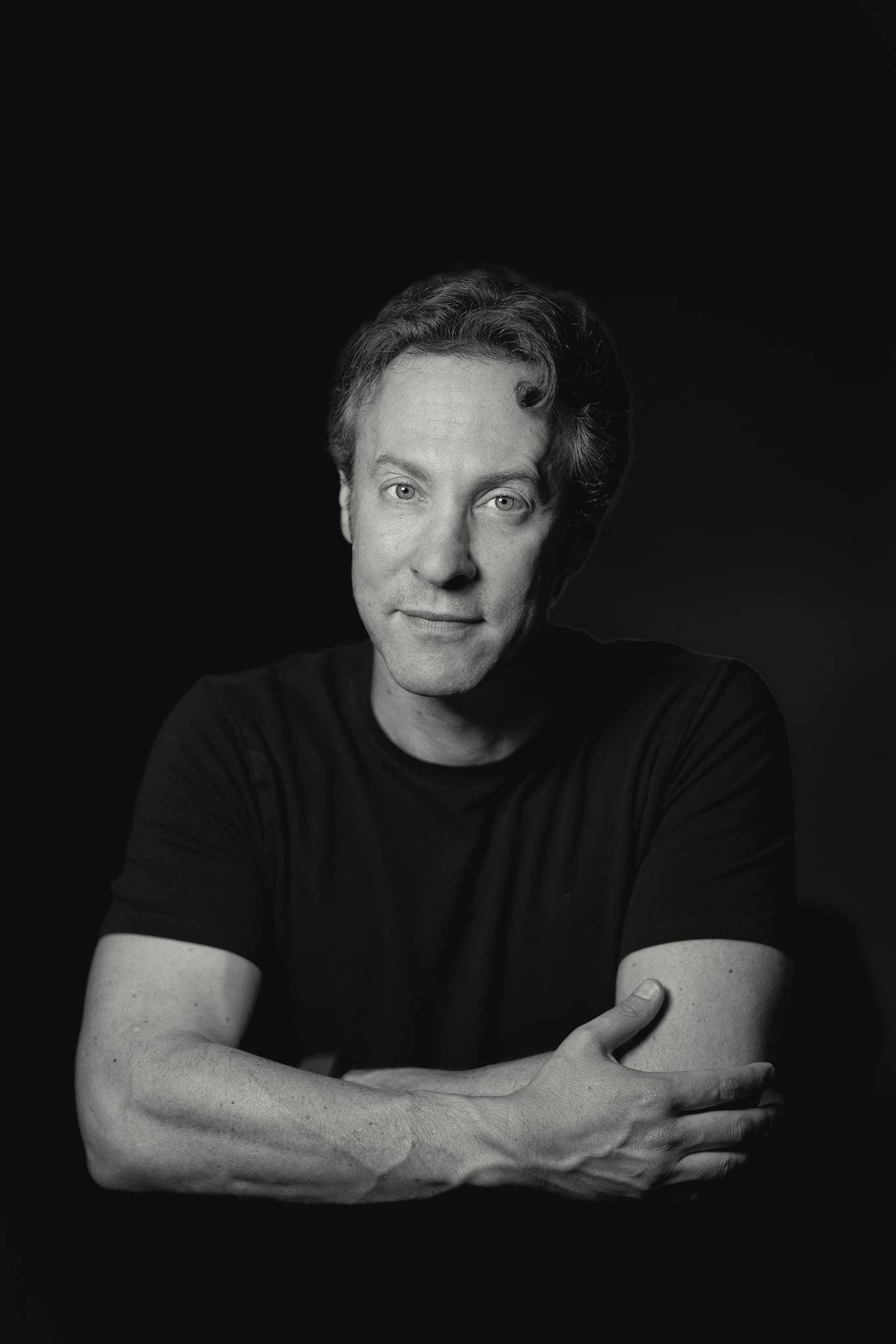
David Eagleman’s home in Los Altos is bathed in golden light, the kind that slips through old Spanish-style windows and rests quietly on books, instruments, and carefully placed artifacts. When I arrived to photograph him in May 2024, I was struck not just by the beauty of the place, but by how completely it reflected its owner: timeless, thoughtful, slightly otherworldly. Eagleman himself greeted me with the open, effortless warmth of someone deeply at ease in both solitude and conversation. Our dialogue, ranging from neuroscience to the afterlife to deep time, felt like stepping into one of his books.
It’s not easy to describe what David Eagleman does without veering into overstatement. Neuroscientist, author, entrepreneur, futurist, he wears each role with fluency, but none capture the full scope of his curiosity. He’s one of those rare thinkers who seems to wake up every morning with the question: What else is possible? And then he goes out and builds a bridge toward it.
Eagleman’s scientific work centers on how the brain constructs reality, perceives time, and adapts through plasticity. He’s best known for exploring the ways we can extend human sensory experience, including through devices that translate sound into touch for the deaf, or enable new senses altogether, technology he’s helped develop through his company Neosensory. For Eagleman, the brain is not fixed, but liveware, a system continuously rewiring itself in response to the world.
But it’s not just science he traffics in. Eagleman is also a gifted storyteller. His 2009 book SUM: Forty Tales from the Afterlives is a slim volume that has quietly become a cult classic, a blend of science, fiction, and philosophy that reimagines death in forty radically different, often heartbreaking, often hilarious ways. One line stayed with me long after our conversation ended:
“Since we live in the heads of those who remember us, we lose control of our lives and become who they want us to be.”
That idea, of identity as a shifting echo in the minds of others, captures so much of what Eagleman wrestles with in his work. Memory, perception, selfhood, they are not constants, but stories under revision. In neuroscience, this has profound implications. In life, it’s poetry.
Eagleman has also become something of a public intellectual, though he might bristle at the term. He’s hosted PBS series, spoken at TED, and written bestsellers like Incognito and Livewired, always walking that delicate line between depth and accessibility. His lectures often leave audiences blinking, as if they’ve just been shown the wiring under the floorboards of their own consciousness.
He is also a thinker drawn to deep time. His affiliation with the Long Now Foundation, a group devoted to fostering long-term thinking, reflects his enduring fascination with what lasts. It’s easy to imagine Eagleman as a kind of cognitive archaeologist, brushing the dust off ancient circuits in the brain, while also designing blueprints for minds that don’t yet exist.
During our session, he moved between quiet intensity and bursts of boyish enthusiasm. He talked about synesthesia, the challenge of writing fiction after years of scientific precision, and the ways the brain compresses and expands time depending on context. At one point, we paused over coffee to watch a hummingbird hover just outside the window and mused that their sense of time must be wildly different from ours.
There’s something deeply human in Eagleman’s approach to science. For all the technology, the brain scans, the AI models, his work circles back again and again to what it means to be alive, and what it might mean to keep evolving.
He once wrote, “There is no afterlife that we know of, but we are living in many others’ minds, and that’s a form of immortality.” Standing in his home, camera in hand, I realized that this too is part of the project, to capture the flicker of a mind at work, to preserve a moment that might one day become memory, then myth.


