
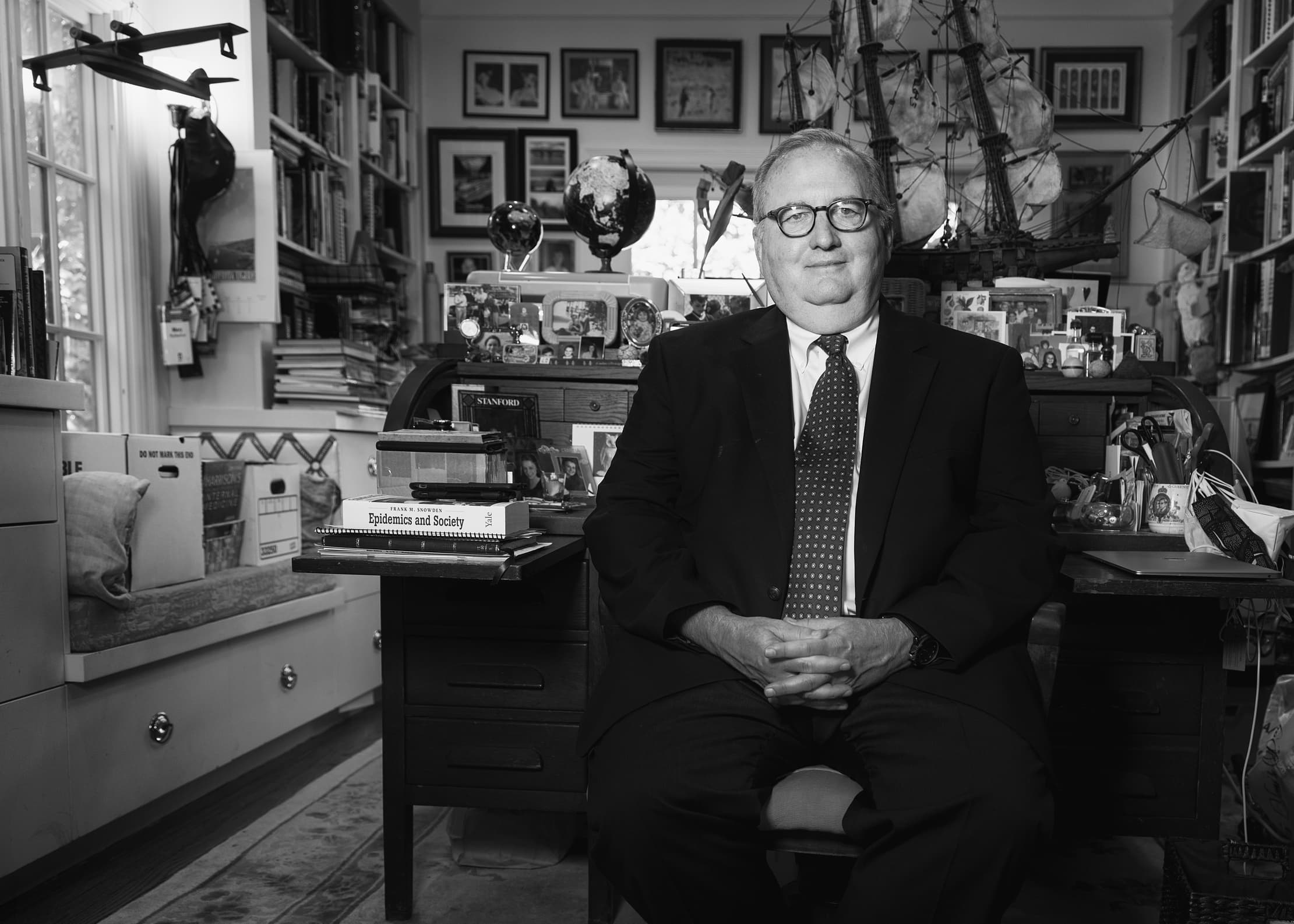
Dr. George Rutherford sits at his desk, surrounded by the artifacts of a life devoted to global public health, books stacked in teetering towers, old epidemiological maps, globes with well-worn latitudes, and photographs chronicling decades of disease response. His home office in Piedmont, where I photographed him on May 4, 2021, felt like a command center of knowledge, an apt setting for a man who has spent his career at the forefront of epidemics, from HIV to COVID-19.
It was the height of the pandemic, and much of our conversation revolved around the crisis at hand, UCSF’s response, the evolving science, and the challenge of communicating uncertainty to a world desperate for answers. Rutherford, a professor of epidemiology and biostatistics at the University of California, San Francisco, had become one of the leading voices of reason during the pandemic, providing clear-eyed analysis in a time of confusion.
His path to public health was not linear but shaped by a restless intellect and an instinct for where he could do the most good. Trained initially as a pediatrician, Rutherford found himself drawn to epidemiology, the study of how diseases move through populations, how patterns emerge, and how outbreaks can be stopped before they spiral into catastrophe. He worked with the Centers for Disease Control and Prevention, the World Health Organization, and a host of other public health institutions, always placing himself at the nexus of policy and science, where decisions must be made quickly and lives hang in the balance.
In the 1980s and 1990s, as the HIV/AIDS epidemic devastated communities, Rutherford played a pivotal role in shaping public health responses. His work at the San Francisco Department of Public Health helped establish critical interventions, from early testing initiatives to harm reduction strategies that would later become global models. Unlike some scientists who remain in the abstract, Rutherford was always on the ground, always in the fray, deeply engaged with the real-world impact of his work.
When COVID-19 arrived, he was uniquely positioned to provide both historical context and real-time guidance. His ability to translate complex epidemiological data into actionable public health advice made him an essential figure in California’s response. He was a frequent presence in the media, offering a steady voice amid the noise, often reminding the public that pandemics are not just biological events but social ones, that the way we respond to a crisis is as important as the virus itself.
Our conversation that day in Piedmont drifted across time zones and epidemics, touching on smallpox eradication efforts, tuberculosis control in sub-Saharan Africa, and the decades-long fight against malaria. His perspective is vast, drawn from years of experience in international public health, and yet he is not weighed down by cynicism. If anything, there is an optimism that runs through his work, an unshakable belief that science, if communicated well and applied correctly, can turn the tide of even the most daunting outbreaks.
The books in his office, some dating back to the earliest days of epidemiology, are reminders that this work is both ancient and ever-evolving. The globes reflect the scale of his concerns, pandemics do not recognize borders, and neither does public health. And the photographs, many of them taken in field hospitals and conference halls, tell the story of a career spent in service of a singular mission: to understand how disease spreads and to stop it before it takes too many lives.
Rutherford remains a professor, a mentor, and an advocate for evidence-based public health. His presence at UCSF is a reminder that science is not just about discovery but about responsibility, to educate, to inform, and to act. And as we sat in his office that day, in the midst of a once-in-a-century pandemic, it was clear that he was exactly where he needed to be, translating knowledge into action, as he has always done.


