
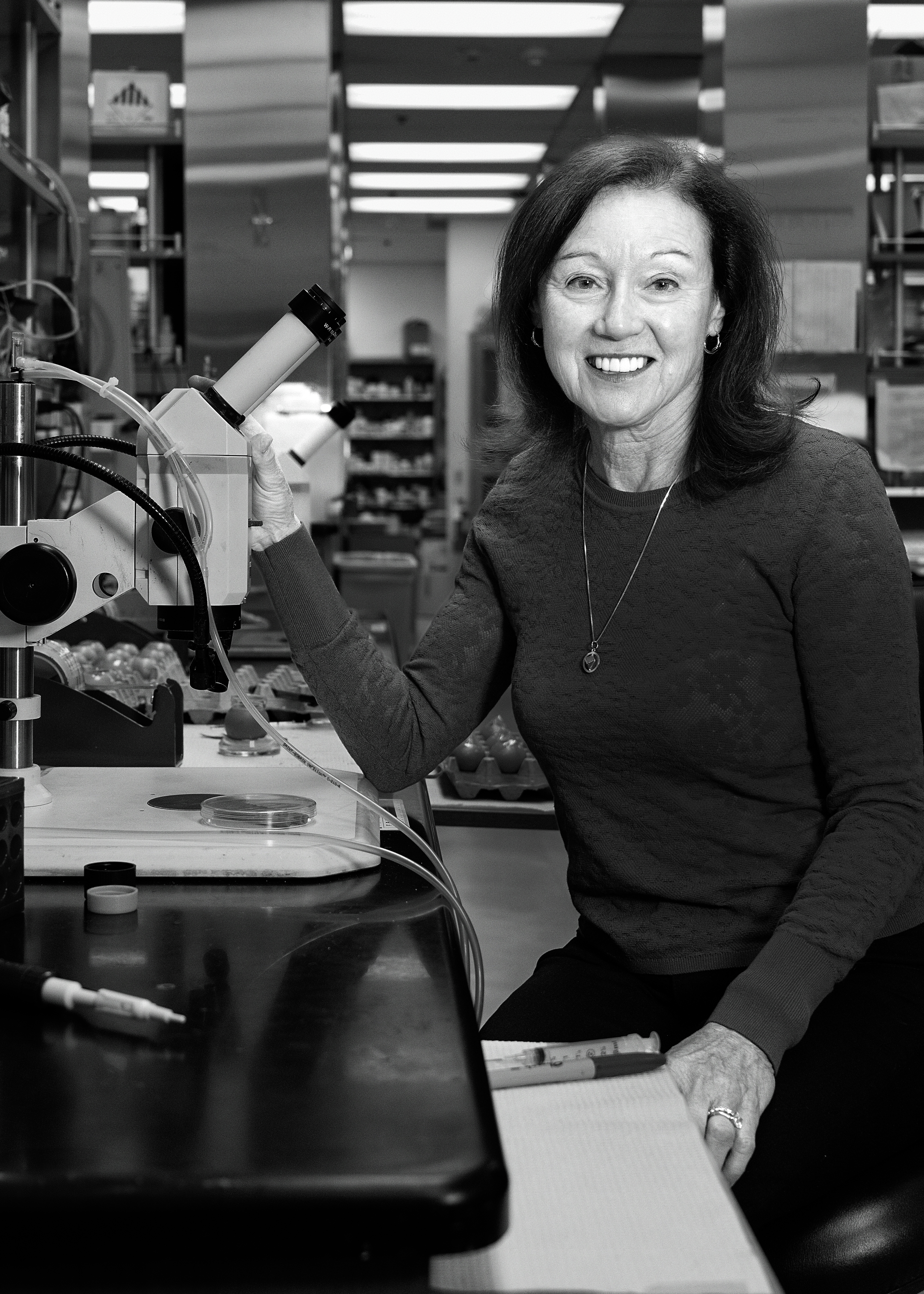
Marianne Bronner has profoundly advanced our knowledge of how complex organisms develop. Her research focuses on the neural crest, a fascinating group of cells that originate near the developing spinal cord and migrate throughout the embryo, differentiating into diverse structures such as facial bones and skin pigment cells. For decades, Bronner has meticulously studied their journeys, revealing the mechanisms behind their remarkable transformations.
I photographed her at Caltech in 2022. She greeted me in her lab with a warm smile and a calm, focused demeanor honed by years of thoughtful research. Surrounded by microscopes and Petri dishes, she seemed perfectly at ease, exuding the quiet confidence of someone deeply connected to her work.
Bronner earned her training in biophysics at Brown University and UC Irvine before joining Caltech in the 1990s. Initially, she explored the electrical properties of nerve cells, but her curiosity soon shifted to developmental biology, specifically the question of how cells determine their fates and destinations. The neural crest became her central focus, a complex puzzle she has pursued throughout her career.
Using live imaging, molecular genetics, and comparative studies across species, Bronner has mapped the behavior of neural crest cells. Her experiments are elegantly designed, but her true strength lies in her ability to ask insightful questions. Her discoveries often stem from careful observation and a deep understanding of biological systems rather than reliance on cutting-edge technology.
Bronner has received numerous accolades, including election to the National Academy of Sciences and the Edwin G. Conklin Medal, yet she rarely discusses her achievements. Instead, she emphasizes her students’ progress, the challenges of ongoing experiments, or the thrill of new ideas. Her leadership at Caltech and in the developmental biology community is defined by generosity and an open, collaborative approach.
In conversation, Bronner is reflective and clear, explaining complex concepts with simplicity while fostering understanding. This clarity extends to her scientific writing, where her papers aim to inform rather than dazzle. She is also a dedicated mentor, having guided numerous students and postdocs, many of whom now lead their own research programs. Her lab is a place where rigorous science and kindness coexist.
Bronner’s career stands out not only for her scientific contributions but also for her approach to her work. She moves forward steadily, asks meaningful questions, and lets her findings speak for themselves. Her influence is evident in the tools she has developed, the researchers she has mentored, and her efforts to foster a more inclusive and thoughtful biology community.
Ultimately, Bronner’s work shows that development is a dynamic process, guided by signals, spatial cues, and timing. Thanks to her contributions, we have a deeper understanding of this intricate process, and her ongoing work continues to inspire.


