
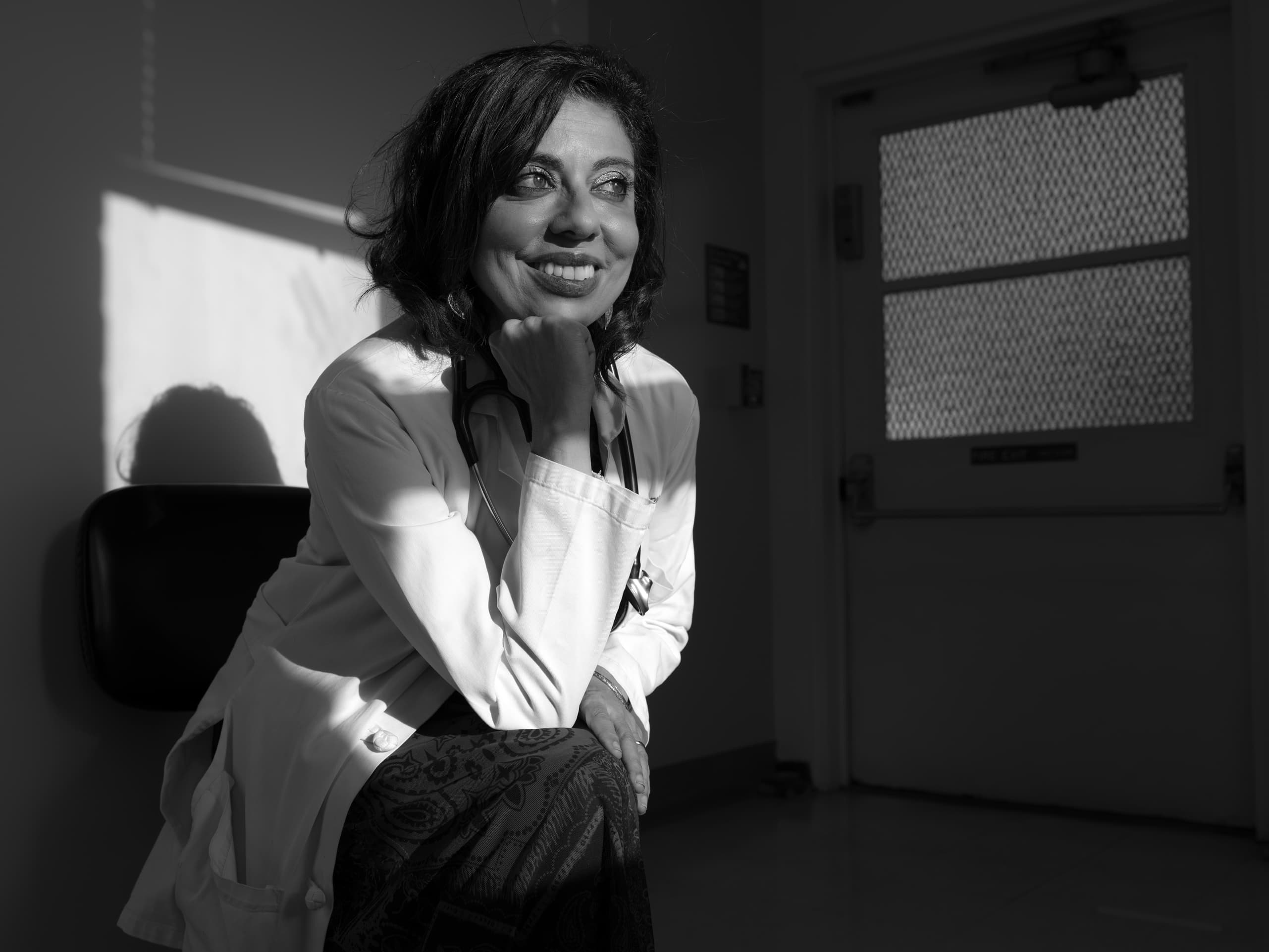
I photographed Monica Gandhi on May 5, 2021, at Ward 86 at San Francisco General, one of the most historically significant HIV clinics in the world. It was the heart of the COVID-19 pandemic, a time of uncertainty, shifting policies, and public anxiety. Gandhi was in the thick of it, writing op-eds, giving interviews, and advocating for a balanced, evidence-driven response to the crisis. She was everywhere, and whether people agreed with her or not, they listened.
She wasn’t just another public health voice repeating the party line. Gandhi was precise, pragmatic, and unafraid to challenge prevailing narratives when the science led her elsewhere. She spoke about risk assessment, the importance of ventilation, and the role of vaccines as the key to moving past fear and restriction. She often found herself at odds with more cautious approaches, pushing instead for policies that accounted for both public health and the human need for connection. Some saw her as a much-needed realist, others as a contrarian, but she was always deeply engaged in the data, unwilling to let ideology drive the response to a pandemic that demanded clear-eyed thinking.
But COVID wasn’t the first pandemic Gandhi had spent her career studying. Her roots were in HIV research, and that background shaped her approach. Ward 86, where we met, was a fitting place, ground zero for the HIV/AIDS epidemic in the U.S. It was there that doctors had fought another deadly virus, one that in its early days was also met with confusion, stigma, and fear. Gandhi had dedicated much of her work to HIV treatment and prevention, with a particular focus on long-acting antiretrovirals, disparities in access to care, and the global fight against the virus. She studied how to simplify HIV treatment regimens for better adherence, how to make care more equitable, and how to develop new ways of preventing transmission, work that had a direct impact on real-world health outcomes.
By the time COVID arrived, Gandhi had spent decades thinking about infectious disease through the lens of both science and public policy. She understood that a virus wasn’t just a biological entity, it existed in a world shaped by politics, fear, and trust. She was particularly attuned to the impact of health policies on the most vulnerable. People living with HIV were disproportionately affected not just by COVID itself, but by the lockdowns and restrictions meant to control it. Many struggled with disrupted care, delayed treatments, and the social isolation that came with shutdowns. Those who were poor suffered the most, public school closures in the Bay Area lasted far longer than those of private schools, widening educational and economic disparities that would persist long after the pandemic was over.
Her work on HIV had also made her a fierce advocate for harm reduction, a philosophy she carried into COVID. She argued that the pandemic response needed to be practical, sustainable, and rooted in what people could realistically adhere to over time. She pushed for policies that focused on protecting the most vulnerable while allowing society to function, drawing from decades of research on how public health measures succeed or fail in the real world. She understood that restrictions had trade-offs, and that shutting down society came with its own set of consequences, particularly for those with the least resources.
When we met, she was warm, focused, and deeply thoughtful. She had that rare quality in a scientist, the ability to hold firm opinions while still being open to new data. She listened carefully, processed everything, and responded with precision. As she stood in the hallway of Ward 86, the history of another pandemic surrounding her, she spoke about the challenges of communication during a crisis. How do you give people clear guidance when the science is still evolving? How do you maintain public trust when policies shift? How do you weigh the costs of restrictions against their benefits? These were the questions she wrestled with daily, not just in academic circles but in the public arena.
Her willingness to step into that arena, to engage in the messiness of public debate, set her apart. It would have been easier to stay in the lab, publish papers, and let others handle the political side of things. But Gandhi believed that science wasn’t just about discovery; it was about application. And in a pandemic, applying science meant communicating it, defending it, and sometimes fighting for it against resistance from all sides.
In the years since, much of what she advocated for, ventilation as a key mitigation strategy, the prioritization of vaccines over prolonged restrictions, and the need for a balanced approach to risk, has become widely accepted. But at the time, it wasn’t always easy to say. She took criticism from those who felt she was too aggressive in pushing for normalcy and from those who thought she wasn’t aggressive enough. She walked that line carefully, always returning to the data.
That day at Ward 86, I saw a scientist who wasn’t just studying history, she was shaping it.


