
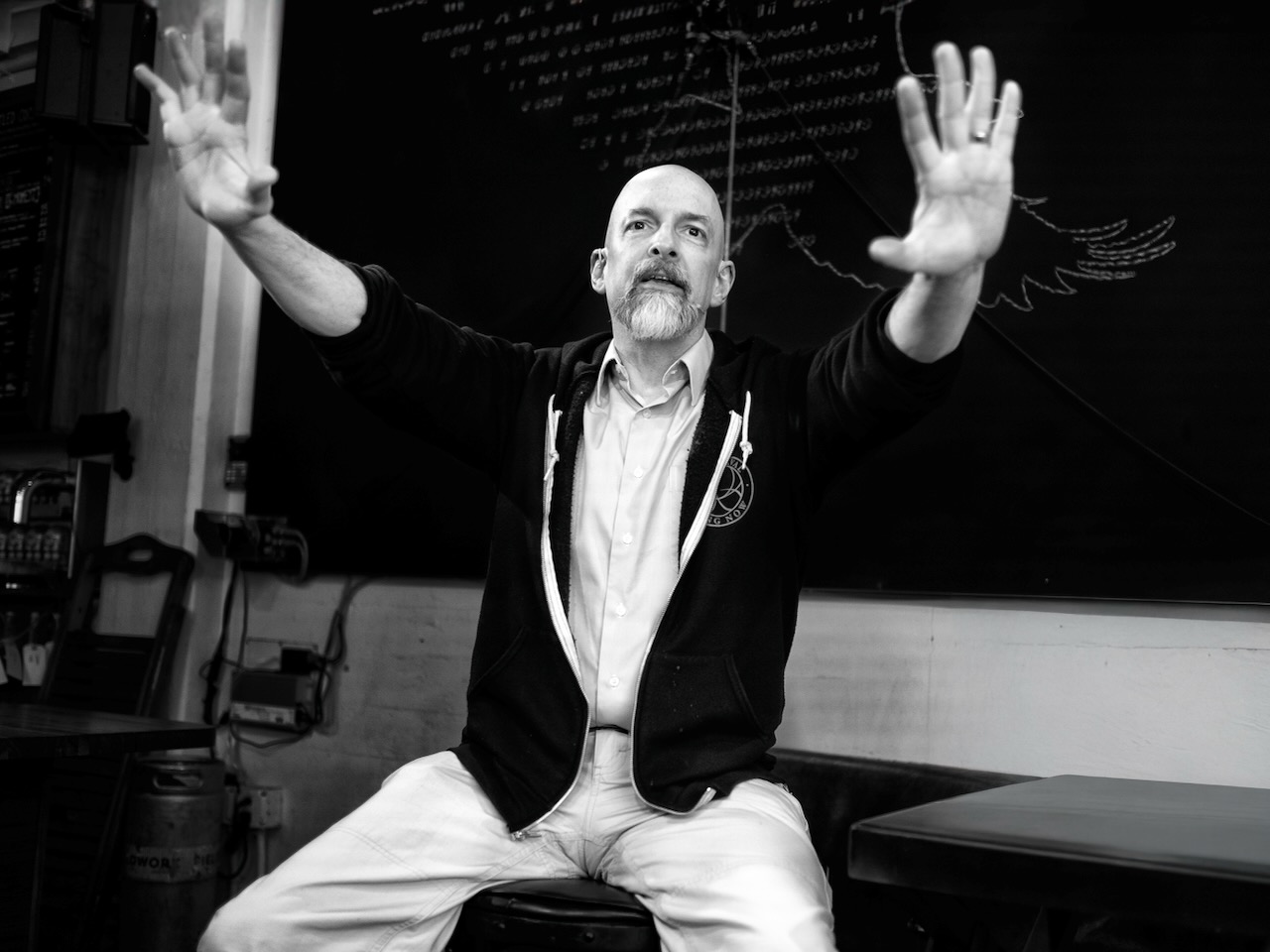
I photographed Neal Stephenson at The Interval, the bar and gathering place of the Long Now Foundation in San Francisco. It’s a space designed for extended conversations and long arcs of thought. Stephenson seemed right in his element there, seated and then suddenly standing, hands lifted as he traced ideas in the air, as if the concepts themselves needed room to breathe.
Stephenson’s books have quietly rewired modern culture. Snow Crash gave us the vocabulary of the metaverse, avatars, and virtual real estate long before those ideas became commercial obsessions. Cryptonomicon brought cryptography, hash functions, and key exchange into the cultural mainstream, framing code as a force that shapes power, privacy, and trust. The Diamond Age imagined nanotechnology not as spectacle but as social infrastructure, asking who benefits when tools become intelligent and ubiquitous. Anathem introduced readers to concentric worlds of math, philosophy, and physics, complete with its own lexicon, a reminder that language shapes how knowledge survives. Seveneves made orbital mechanics, delta v, and long term survival unavoidable, insisting that physics sets the terms whether we like them or not. Reamde and Fall or Dodge in Hell explored digital identity, online economies, and the persistence of consciousness inside engineered worlds.
Stephenson has a gift for naming things in ways that stick. His terminology migrates from fiction into boardrooms, labs, and design documents. He understands that once something has a name, it becomes discussable, arguable, buildable. His novels are dense with systems and constraints, with footnotes of implication. He does not smooth complexity away. He invites readers to meet it head on.
That approach has shaped generations of technologists, scientists, and builders who grew up reading him. His work encourages respect for first principles and suspicion of hand waving. It frames technology as something that accumulates consequences over time, not something that resets cleanly with each new version.
Culturally, Stephenson sits at the intersection of imagination and engineering. His stories influence how people think about networks, money, space, and civilization itself. Photographing him at the Long Now felt inevitable. His work is anchored in deep time. It asks what scales, what breaks, and what endures when decades and centuries are allowed to pass. In a culture addicted to immediacy, Stephenson keeps pointing the lens outward and forward, insisting that the long view still matters.


