
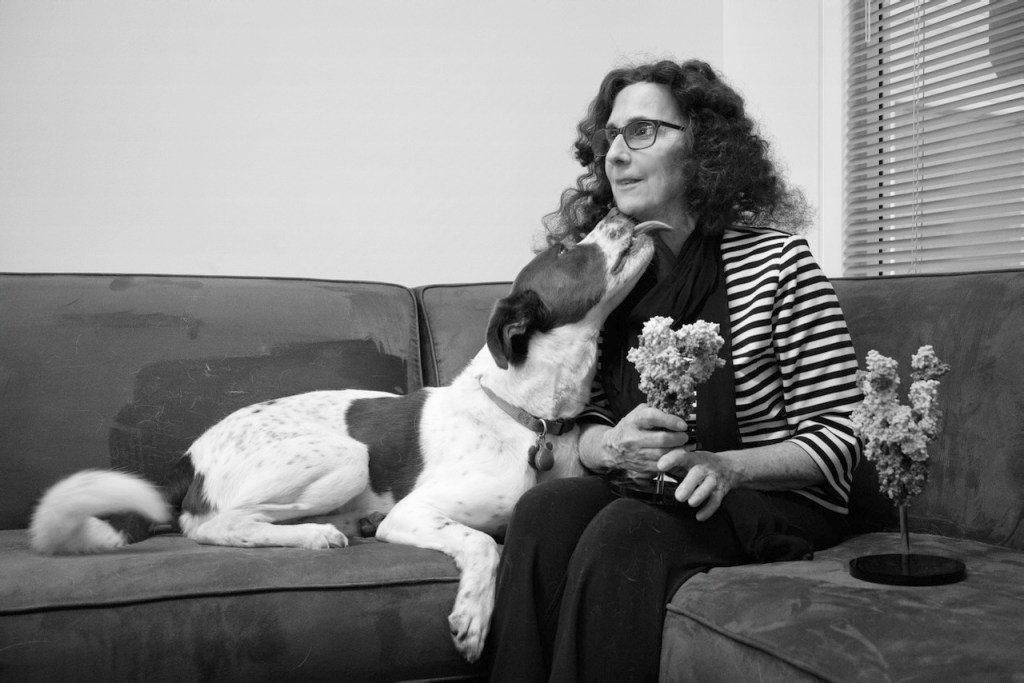
Pamela Bjorkman sat on the couch in her Caltech office, a bouquet of molecular models in one hand and her dog Bilbo pressed warmly into her side. Bilbo had no intention of letting the moment pass without offering lots of love for his dog-mom. She smiled without moving, eyes forward, letting him have his moment. It was a portrait of ease, of affection, and of the rare kind of person who can hold the complexity of the immune system in one hand and her beloved pup in the other.
Bjorkman has spent her life decoding the invisible. A pioneer in structural biology, she was among the first to reveal how the immune system distinguishes between self and non-self, work that reshaped the field and brought clarity to the molecular dance at the heart of immunity. Her landmark studies on the major histocompatibility complex gave scientists their first real look at how cells present viral and bacterial fragments to immune sentinels. It was a foundational breakthrough, one that continues to guide therapies and vaccines to this day.
But her reach extends beyond that early work. Over the years, she has applied increasingly powerful imaging techniques including x-ray crystallography and cryo-electron microscopy to probe the structural underpinnings of diseases like HIV and COVID-19. Her lab studies how viruses hide from the immune system, and how our bodies, in turn, can be taught to recognize them. It is intricate, slow, often frustrating work. But in Bjorkman’s hands, it becomes an act of clarity and care.
She is not a loud presence in science. Her influence moves more like a tide than a wave. She trains her students with patience. She speaks precisely and with purpose. She does not condescend. If she is admired and she is it is because of the quiet consistency of her vision and the integrity of her science.
There is no separation between the personal and professional in her workspace. The protein models on the table sit beside dog treats. Papers and journals share space with Bilbo’s blanket. In that setting, nothing feels out of place. It is a reminder that great science is still human work. That the mind capable of understanding the fine structure of an antibody is also the same one that chooses kindness over pretense, substance over show.
Bjorkman doesn’t draw attention to herself, but her impact is profound. Her discoveries have made possible the development of broadly neutralizing antibodies. Her leadership has influenced how young scientists think about research as a long game, a collaborative effort, a moral pursuit. And she has done it all while staying rooted in the day-to-day details of lab life, dog hair and all.
Bilbo knows. He doesn’t care about the medals, the academy memberships, the groundbreaking papers. He just knows who she is. And maybe that’s the clearest truth of all.


