
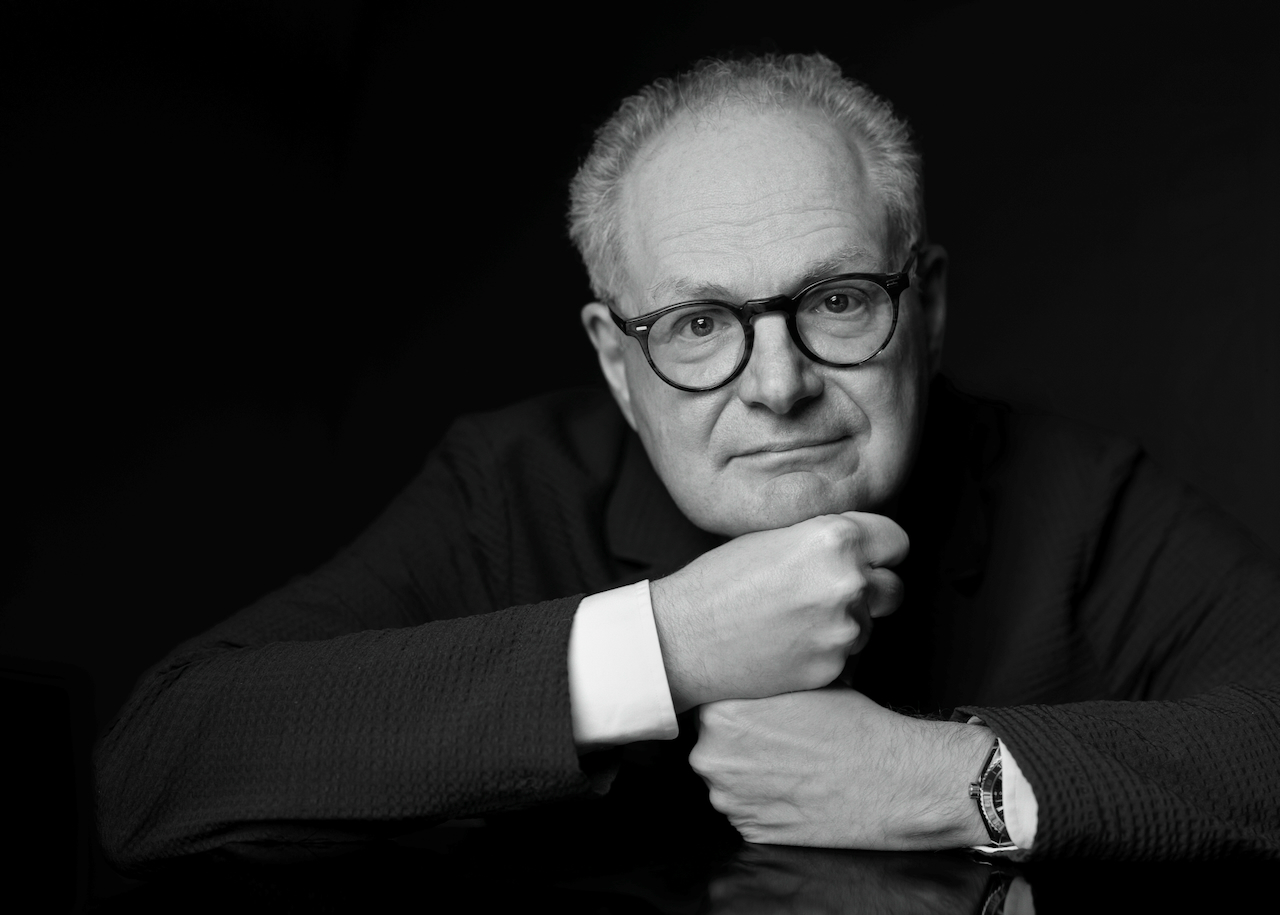
Paul Alivisatos has spent a lifetime working at scales most of us never directly see, where matter behaves in ways that feel almost counterintuitive, where size alone begins to change the rules. Yet to meet him in person is to encounter something entirely human. There is no distance, no sense of hierarchy. Just curiosity, attention, and a kind of quiet generosity.
I photographed him at his longtime home in the Berkeley Hills on a hot Bay Area afternoon, the light sharp and dry, the air still. He was in town from Chicago, where he now serves as president of the University of Chicago. We sat and talked before making any images. About science, of course, but also about photography. He spoke easily about Leica cameras, about the way a lens frames attention, about what it means to really see something. It felt natural that someone who has spent decades studying the structure of matter would also care about the act of observation itself.
Paul’s scientific work reshaped how we understand materials at the nanoscale. He is one of the pioneers of nanoscience, known for his work on semiconductor nanocrystals, often called quantum dots. These are particles so small that their optical and electronic properties shift with size. Change the diameter by a few nanometers and the color of light they emit changes. It is precise, almost poetic physics. His research helped open entire fields, with applications ranging from biological imaging to solar energy.
But what stayed with me from our conversation was not the technical achievement. It was his relationship to the unknown.
We talked about quantum mechanics and the strange position it holds. A theory of immense predictive power, one that underpins modern technology, yet still leaves open the deeper question of mechanism. Do we truly understand what is happening, or have we built an extraordinarily effective map that still hides the terrain beneath it? Paul leaned into that uncertainty with ease. Not as a problem to be solved quickly, but as a space worth inhabiting.
That posture seems to define him.
His career has moved between discovery and leadership without losing contact with either. Before Chicago, he served as Executive Vice Chancellor and Provost at the University of California, Berkeley, and as Director of Lawrence Berkeley National Laboratory. These are roles that demand an ability to think in systems, to guide institutions that span thousands of people and decades of work. And yet he still returns to the lab. A couple of times a week, he works alongside students, including undergraduates, staying connected to the direct experience of inquiry.
He told me that at the University of Chicago, nearly every day brings a conversation or event where he learns something new. You get the sense that this is not a line he offers lightly. He seems genuinely animated by the possibility of learning, whether from a colleague, a student, or a completely different field. There is no narrowing, no retreat into what he already knows. If anything, the range is widening.
There is also a kind of steadiness to him. A grounded optimism. He engages fully, listens closely, and responds with care. Even small gestures reflect that. At the end of our time together, after the photographs were made, he walked me up the long set of stairs from the house all the way to my car. It was not performative. It was simply who he is.
It is easy to focus on the scale of his accomplishments. Pioneer of nanoscience. Builder of institutions. President of one of the world’s leading universities. But those labels flatten something essential.
Paul operates comfortably across layers. From the quantum behavior of particles to the structure of large organizations, from the abstract to the personal. And through all of it, there is a consistent thread. A belief that understanding is never finished. That learning is not a phase but a condition. That attention, whether through a microscope or a camera lens, is an act of respect.
You leave a conversation with him feeling seen. And also reminded that the world, even now, still holds more to discover than we can quite explain.


