
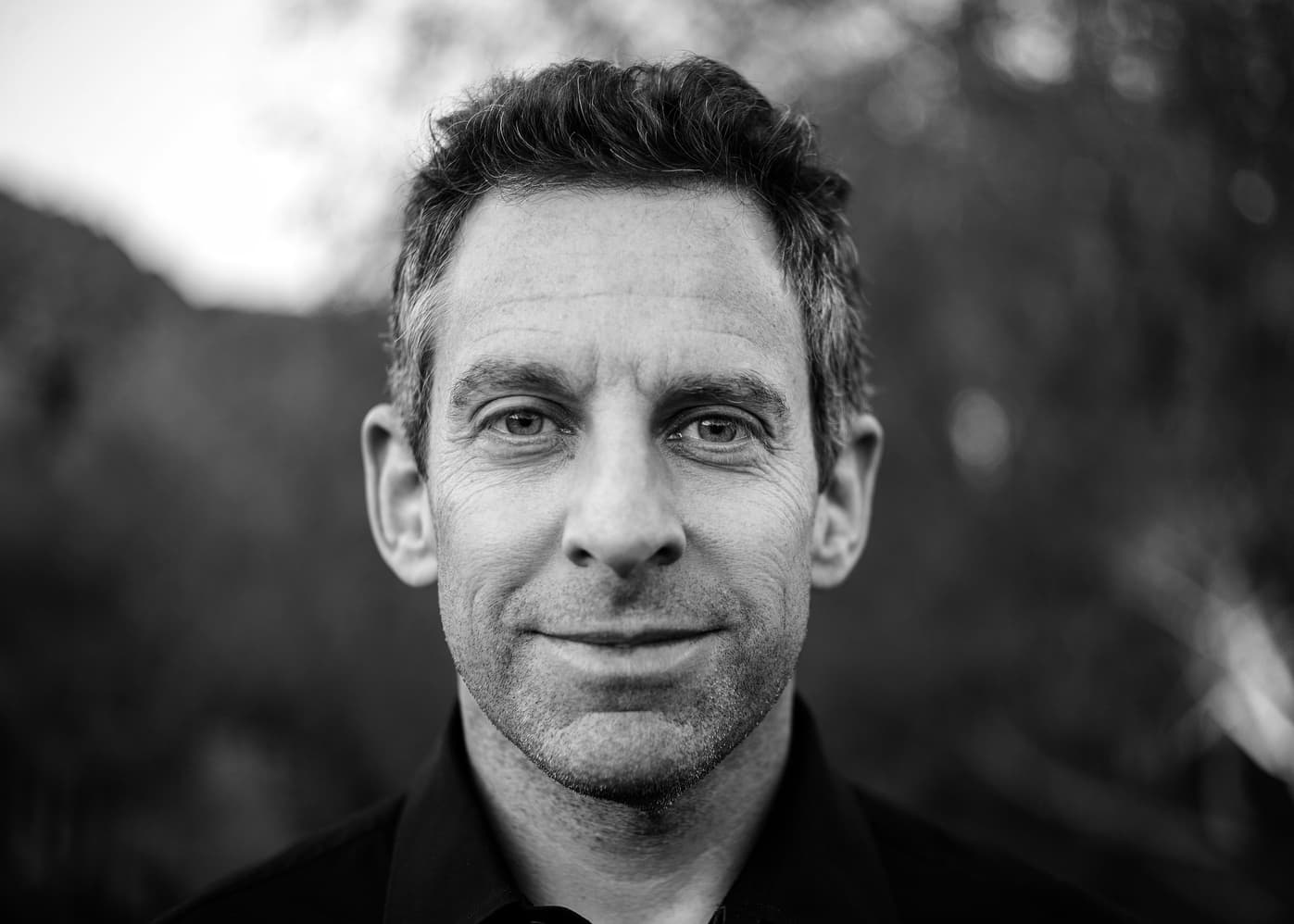
Sam Harris has always been a man of precise words and razor-sharp thoughts, his voice carrying the clipped cadence of someone who has spent a lifetime considering each syllable before speaking it aloud. When I photographed him in March of 2016 at Dove Mountain, Arizona, I was struck by his stillness. He has the presence of someone who is not merely thinking, but thinking about thinking, plumbing the depths of consciousness with the same intensity a mountaineer might study a precipice before making the ascent.
Born in 1967, Harris is best known as a neuroscientist, philosopher, and writer who has spent decades interrogating the human condition. He first gained widespread attention with his book The End of Faith (2004), a fierce and unflinching examination of religious belief that won the PEN/Martha Albrand Award for First Nonfiction. In it, Harris argued against the dangers of dogma with the kind of cool, analytical detachment usually reserved for lab reports, making the case that faith, unchecked and unquestioned, was one of civilization’s great existential threats. The book, written in the wake of September 11th, made him both a hero and a heretic, a role he seemed to accept with the quiet assurance of a man who expected no less.
His intellectual journey has been one of relentless inquiry, unafraid to step into the fray of controversy. Whether tackling free will, artificial intelligence, or the moral implications of neuroscience, Harris approaches each subject with the rigor of a scientist and the tenacity of a trial attorney. His book Free Will (2012) presents a case against the very idea of human volition, arguing that our actions and thoughts are dictated by prior causes beyond our control, a notion as unsettling as it is liberating. He moves easily between philosophy and empirical science, grounding his arguments in the latest research on the brain while never losing sight of their broader implications.
Yet, for all his cerebral intensity, Harris is not without a deep fascination with the subjective, with the inner world of experience. His book Waking Up (2014) is a testament to this, an attempt to reconcile the apparent contradiction between rigorous rationality and the profound states of consciousness explored in meditation. Having spent time in silent retreats, studying under Buddhist teachers, and experimenting with psychedelics, Harris has sought to strip spirituality of its supernatural trappings and ground it in something more defensible: the raw, unfiltered reality of direct experience.
This tension, between the rational and the experiential, the cold precision of science and the warmth of personal insight, is what makes Harris such a compelling figure. His Making Sense podcast, launched in 2013, serves as an intellectual salon of sorts, a place where he engages with scientists, philosophers, writers, and thinkers across disciplines, from artificial intelligence experts to moral philosophers. He is never afraid to challenge his guests, nor does he shy away from re-examining his own positions. In conversation, as in his writing, Harris wields clarity like a scalpel, his arguments honed to their sharpest edge, his questions cutting straight to the heart of a matter.
The man I met at Dove Mountain was much as I expected: deliberate, measured, and strikingly present. He had a way of looking at you that made it clear he was not just waiting for his turn to speak but genuinely absorbing what you said, weighing it against the vast architecture of ideas he carried within him. There was an intensity in his silence, the sense that his mind was constantly at work, peeling back layers of assumption to examine the bare scaffolding underneath.
Harris is, above all, a seeker, a man who has spent his life charting the contours of belief, knowledge, and consciousness with the precision of a cartographer mapping an undiscovered world. He does not offer easy answers, nor does he indulge in comforting illusions. Instead, he asks us to look unflinchingly at the reality before us, to question, to examine, to think. And in doing so, he invites us into the great, unfinished conversation that is the pursuit of truth.


