
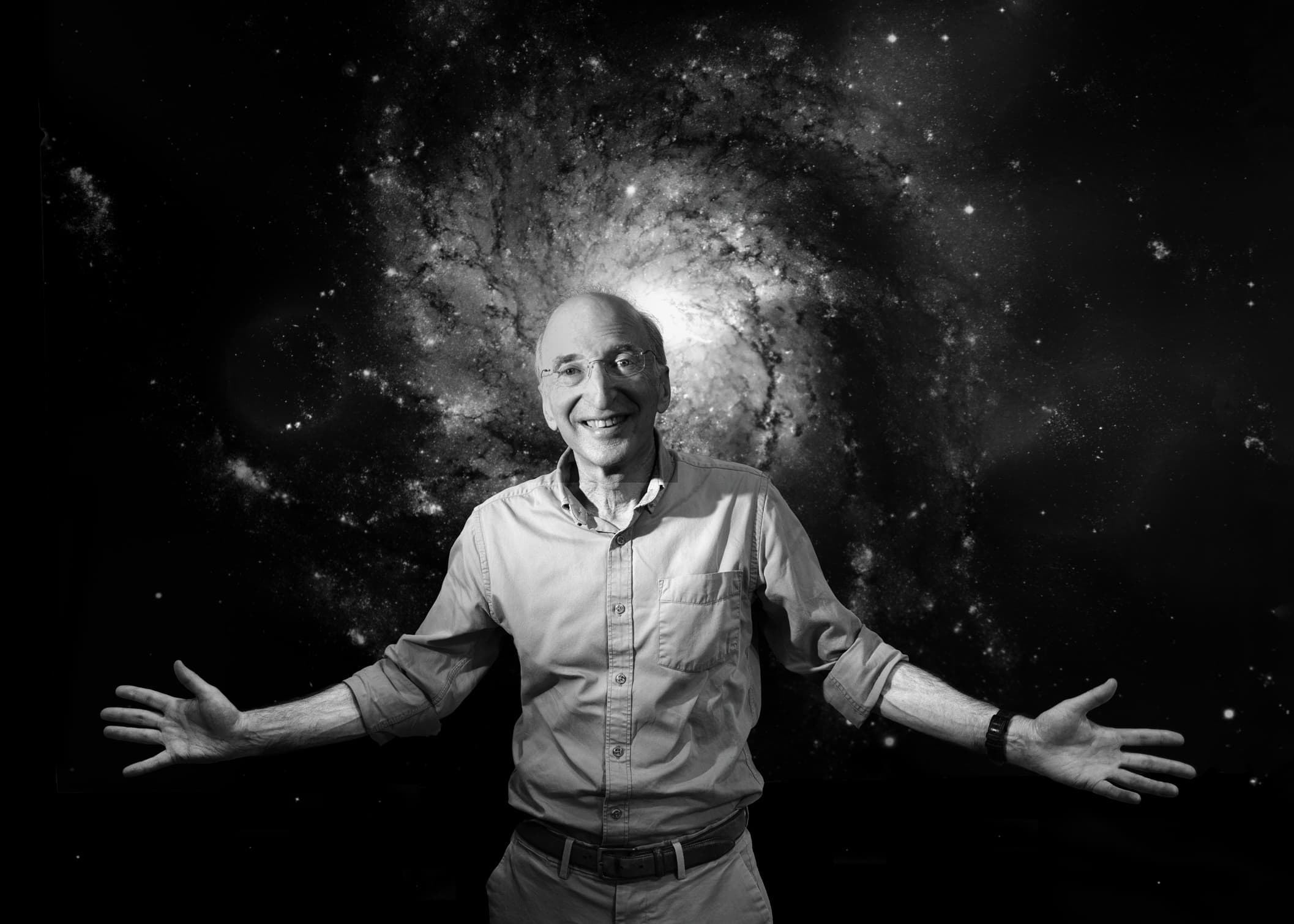
Saul Perlmutter is a physicist whose work reshaped our understanding of the universe. In the 1990s, leading a team of astronomers at Lawrence Berkeley National Laboratory, he set out to measure the deceleration of the universe’s expansion, what most cosmologists at the time assumed would be the inevitable slowing caused by gravity tugging on galaxies. Instead, what he found startled everyone: the universe wasn’t slowing down. It was speeding up. Galaxies weren’t coasting gently apart; they were accelerating away from each other, faster and faster, as if pushed by some invisible hand. That hand was eventually named “dark energy,” a placeholder for a force we still barely comprehend but now believe makes up nearly 70% of the cosmos.
It was a discovery that rewrote the standard model of cosmology. Alongside the competing High-Z Supernova Search Team, Perlmutter’s Supernova Cosmology Project helped confirm what no one had anticipated. In 2011, Perlmutter was awarded the Nobel Prize in Physics for this work, sharing it with Brian Schmidt and Adam Riess, leaders of the rival team. But beyond the awards and citations, the revelation marked a turning point in our understanding of the universe’s fate. The cosmos, it seemed, would not collapse back on itself in a “Big Crunch.” It would keep expanding forever…cold, vast, and increasingly lonely.
I photographed Perlmutter on August 20, 2024, at Lawrence Berkeley National Laboratory, the scientific citadel perched high above the Bay, tucked into the hills like a secret temple of reason. Once through security, I was directed to follow Perlmutter Avenue and meet him at the Perlmutter Supercomputer. That was my first clue. This must be someone whose impact on science goes far beyond the footnotes.
He arrived in the chill and quiet of the supercomputer facility with a warm smile and a violin in hand. He wore a soft blue shirt, sleeves rolled up, and moved with the ease of someone comfortable in his own contradictions. Quantum theorist. Amateur musician. Relentless empiricist. Playful humanist. In the low hum of the server room, surrounded by blinking lights and the soft exhalations of processors cooling themselves, Perlmutter lifted his violin and played.
It was unexpected, and strangely moving. There, in a room optimized for brute-force computation, he introduced something entirely analog, ephemeral, and personal. His music wasn’t for performance. It was a kind of offering. A moment of beauty amid the machinery. A reminder that science, for all its rigor, is ultimately a human enterprise. We build machines to extend our senses, but it’s our sense of wonder that guides them.
After the music faded and the servers resumed their silent labor, we walked the campus. The conversation flowed easily, from dark matter to telescope time allocation, from the fate of the universe to the importance of uncertainty. Perlmutter has the rare gift of talking about profound scientific ideas without cloaking them in jargon. His metaphors are vivid. His analogies, disarming. Listening to him explain dark energy is a bit like watching a magician reveal the trick, not with bravado, but with delight that you might now see the world a little differently too.
He talked about the early days of the Supernova Cosmology Project. It was, in many ways, a long bet. Measuring the light from distant Type Ia supernovae, exploding stars that serve as “standard candles”, required painstaking observations, international collaboration, and no small amount of patience. The data trickled in. The equations didn’t behave. And then came the moment no one expected: the curve bent the wrong way. The distances didn’t match the expected slowing of cosmic expansion. Instead, the supernovae were fainter than predicted, farther away than they should have been. The universe wasn’t just expanding. It was accelerating.
It’s hard to overstate the shock of that discovery. Cosmology had always been a kind of grand bookkeeping, measuring the visible universe and trying to infer its destiny. But this was different. This was a force that no one had accounted for, that emerged not from theory, but from stubborn data. “Dark energy” was born from this disobedience of the cosmos. It was a label, not an explanation. A term that contained both awe and ignorance.
Perlmutter never pretends to have all the answers. In fact, what’s striking is how comfortable he seems with mystery. He radiates a kind of philosophical patience. “It’s not that we want to believe in dark energy,” he said, smiling. “It’s just that the universe seems to insist on it.”
There’s a quiet persistence to the way he talks about science. He’s not flashy. He doesn’t speak in declarations. He nudges ideas forward, invites curiosity, makes space for nuance. Even his Nobel moment, he recalls without grandeur. “We were lucky,” he says. “We had good people. And we listened to what the data told us.”
That humility is part of what makes him such a compelling figure. He seems more energized by the questions that remain than the ones already answered. What is dark energy, really? Is it a property of space itself? A fifth force? Evidence of a multiverse? No one knows. And that’s the point.
Perlmutter’s career has spanned decades of observational cosmology, but he’s also spent years thinking about how science fits into society, how we teach it, how we trust it, how we use it. At Berkeley, he helps lead interdisciplinary programs that explore the boundaries between physics, philosophy, and public understanding. The violin, it turns out, isn’t a metaphor. It’s a practice. A way of tuning himself, perhaps, to something larger.
As we said goodbye, I was struck by the idea that for all the supercomputers and telescopes and Nobel medals, the most powerful tool in science might still be a well-asked question. Saul Perlmutter has made a career out of asking them, not to tame the universe, but to better live in its expanding mystery.
In his presence, you get the sense that physics isn’t just about matter and energy. It’s about awe, imagination, and the humility to be surprised. The universe, after all, had a secret. He listened. And it told him.


