
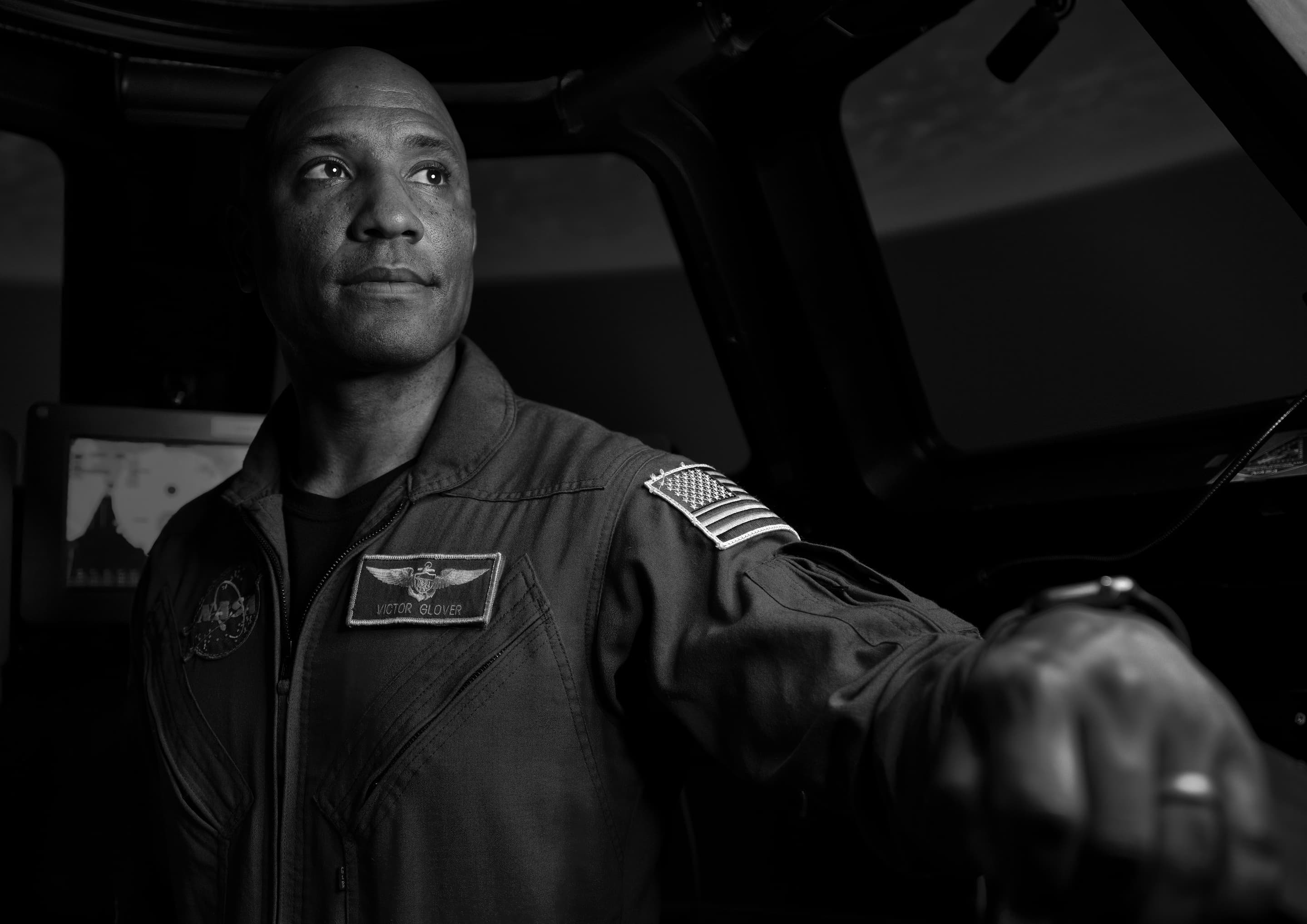
Victor Glover has the kind of presence that settles a room before he says a word. When I photographed him at Johnson Space Center, he was in a quiet corner of the simulator, blue flight suit catching just enough light to separate him from the dark. He looked up for a moment, thoughtful, alert, as if listening to something just out of frame. Then the smile came. Wide, disarming, immediate. The kind of smile that makes you feel like you are already part of the team.
Shipmates know him as IKE. It is said half jokingly as “I know everything,” but the phrase lands differently when you spend time with him. It is not about ego. It is about competence. A deep, earned confidence built over decades of doing hard things in unforgiving environments. Navy test pilot. Combat aviator. Engineer. Astronaut. Each step adds another layer, but none of it feels heavy on him. He moves easily between disciplines, between people, between stakes.
Victor grew up in Pomona, California, the son of parents who emphasized both discipline and curiosity. He studied engineering at Cal Poly, San Luis Obispo, then went on to earn advanced degrees while serving in the U.S. Navy. As a pilot, he flew F/A-18s in combat and logged thousands of flight hours in more than 40 different aircraft. Test pilot school followed, where the margins shrink and precision becomes a form of language. It is one thing to fly. It is another to understand the machine well enough to push it to its limits and bring it back intact.
NASA selected him in 2013. Even among astronauts, where excellence is the baseline, Victor stands out for how completely he integrates the technical and the human. On his first mission, SpaceX Crew-1 in 2020, he became the first Black astronaut to live aboard the International Space Station as part of a long-duration crew. During that mission, he conducted spacewalks, supported a wide range of scientific experiments, and spent months in microgravity learning the rhythms of life off the planet. He also carried something less measurable. Representation. Not as a talking point, but as a lived reality. Presence matters. He understands that, and he handles it with quiet seriousness.
Now he is part of Artemis II, NASA’s first crewed mission around the Moon in more than fifty years. It is a different kind of flight. Not a destination landing, not yet, but a proving run for everything that comes next. The spacecraft will leave Earth orbit, swing around the far side of the Moon, and return. It will test systems, procedures, and people in deep space again. Victor serves as pilot on that mission, working alongside commander Reid Wiseman and mission specialists Christina Koch and Jeremy Hansen. It is a crew that reflects where the program is going, technically and culturally. The stakes are high, but the tone inside the group feels grounded. Focused. Professional.
When you talk with Victor, what comes through is not just capability but clarity. He understands the chain of decisions that lead to success or failure. He understands teams. He listens. He asks questions that are direct and useful. There is no excess. No performance. Just attention to what matters and a willingness to carry responsibility without making it about himself.
At Johnson, between setups, we talked about flying, about family, about the strange mix of routine and risk that defines this work. He described spaceflight not as something abstract or heroic, but as a job that demands preparation and trust. Trust in the people beside you. Trust in the systems you have trained on for years. Trust in your own judgment when things get complicated, which they always do.
There is a moment in every portrait session where the subject either leans into the camera or holds something back. Victor leans in, but not in a way that feels posed. More like he is meeting you where you are. That is part of what makes him effective. Down to earth in the most literal sense. Fully aware of the magnitude of what he is doing, and completely unburdened by the need to perform it for others.
Artemis II will carry him farther from Earth than he has ever been, farther than most humans have ever been. Out past the familiar blue edge, into a place where Earth becomes a small, bright object in a black field. It is easy to romanticize that view. Victor does not need to. He will do the job. He will help bring the crew home. And somewhere in that arc around the Moon, there will be a quiet moment when the work and the wonder meet, and he will take it in, just as he does everything else.


