
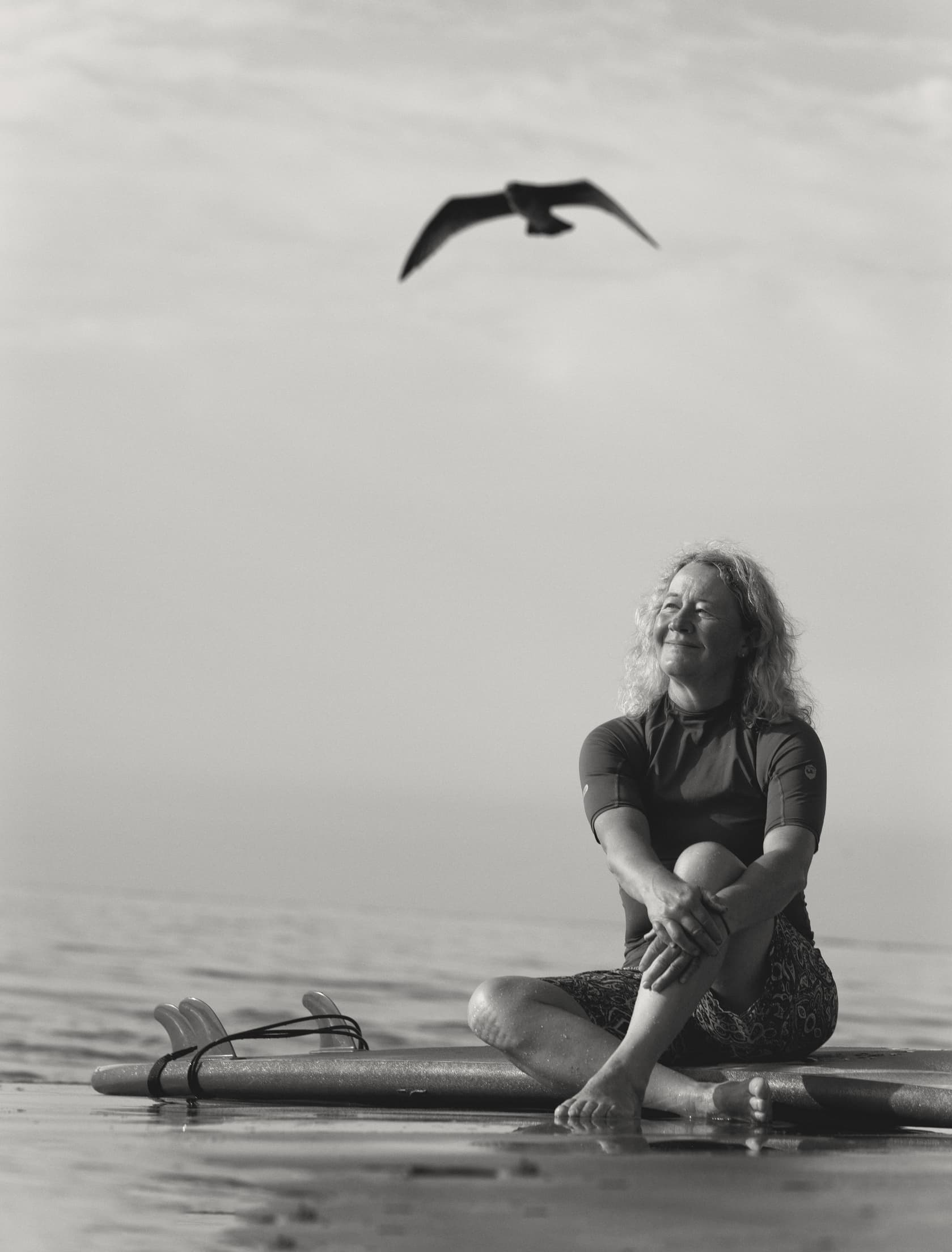
Carol Greider’s life is a study in persistence, both in the lab and on the waves. I photographed her at UC Santa Cruz, surrounded by the quiet hum of scientific inquiry, and later, balanced on a surfboard with the Pacific stretching endlessly around her. In both places, there was the same steady focus, the same calm readiness to face whatever came next.
Long before the Nobel Prize, before the accolades and recognition, Greider was a young scientist working late into Christmas Eve in 1984 when she first glimpsed what would become one of biology’s most profound discoveries. Alongside her mentor Elizabeth Blackburn, she identified telomerase, an enzyme that maintains the protective caps at the ends of chromosomes known as telomeres. It was a breakthrough that reshaped our understanding of cellular aging, cancer, and genetic stability.
For that discovery, Greider shared the 2009 Nobel Prize in Physiology or Medicine. Yet, speaking with her, you quickly realize that the prize isn’t a destination in her story. It’s a milestone along a path she’s never stopped walking. At UC Santa Cruz, her lab continues to explore the intricate dance of chromosomes, mutations, and the mechanisms that determine how cells live, divide, and die. Her work doesn’t just sit in textbooks; it ripples outward into medicine, aging research, and cancer therapies.
And then there’s the ocean. Watching Carol sit on her board, saltwater swirling around her ankles, it became clear that surfing isn’t an escape from science. It’s part of the same rhythm. The patience to wait for the right wave mirrors the patience to follow a question through years of experiments. The resilience to wipe out and paddle back out is the same resilience that carried her through the challenges of early-career skepticism and the long, meticulous work that science demands.
Carol Greider’s story is not just about discovery. It’s about endurance, curiosity, and the ability to find balance in complexity. Whether charting the unseen architecture of our DNA or reading the subtle shifts of the sea, she moves through both worlds with a quiet mastery. The Nobel may honor a single discovery, but her true legacy is the ongoing pursuit, a life dedicated to understanding how we endure, at the cellular level and far beyond.


