
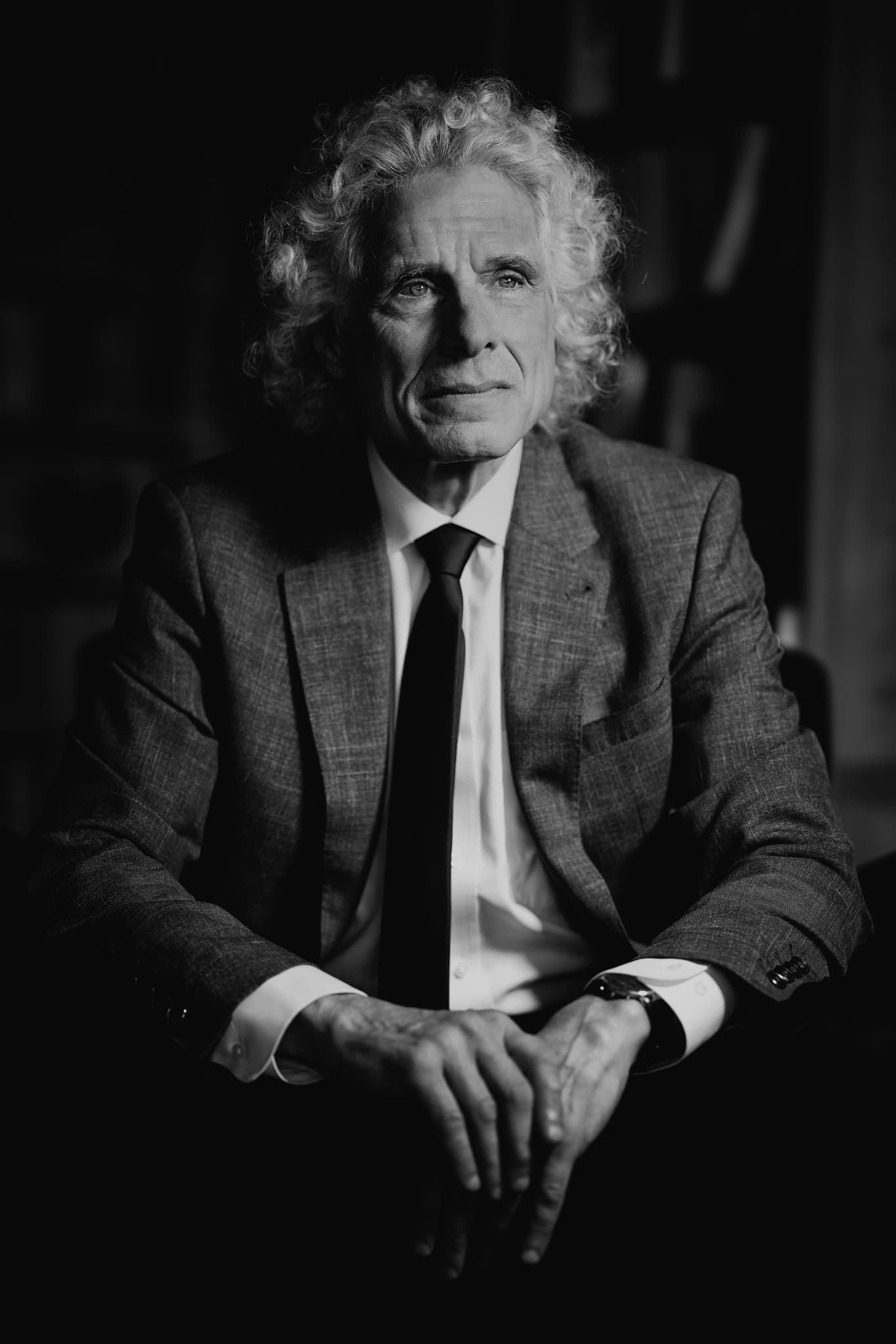
Dr. Steven Pinker is a cognitive psychologist, linguist, and provocateur of thought, a man who sees not just the mechanisms of human language and reason but the grand trajectory of human progress itself. His work, both rigorous and audacious, challenges the prevailing notion that we are doomed to decline, arguing instead that reason, science, and human ingenuity have steadily lifted civilization into an era of unprecedented prosperity.
I photographed Pinker on October 4, 2023, in his spacious office at Harvard’s William James Hall. The grey Boston light seeped through the large windows, giving the space a contemplative air. Books, papers, and artifacts filled the room, the detritus of an ever-active mind. He sat in a large chair, curls haloing his head, his gaze sharp yet amused. Then, with an almost theatrical flourish, he lifted a human brain in a jar. It was, in that moment, a perfect distillation of his work, holding in his hands the very subject of his lifelong inquiry.
Pinker is a scientist unafraid to wade into controversy, to take apart the narratives of pessimism and decay that so often dominate our discourse. His books, including *The Better Angels of Our Nature* and *Enlightenment Now*, argue that human life is longer, healthier, and less violent than ever before, a claim he supports with an almost obsessive commitment to data. In conversation, he does not merely make assertions, he builds arguments, constructing them with the precision of an engineer and the playfulness of a storyteller. His is a mind that delights in complexity yet insists on clarity, distilling vast historical and psychological forces into something tangible, graspable.
Few scholars move so seamlessly between the realms of academia and public discourse. Whether defending rationality against its many detractors, advocating for free thought in an age of ideological rigidity, or challenging the very notion of free will, Pinker remains relentless in his pursuit of truth. His mind is a lens, clarifying the murky waters of human nature and society, and in his presence, one cannot help but feel the irresistible pull of reason itself.


